Showing posts with label PRC. Show all posts

Saturday, January 19, 2013

USPS's Inaccurate Annual Compliance Data: CPUs

The U.S. Postal Service provides to the Postal Regulatory Commission data regarding all parts of its operations. While there are lots of fascinating tidbits all around, my primary interest as the 'postal tourist' involves information regarding USPS's physical infrastructure. To me this includes Post Offices, classified stations and branches, carrier annexes, and mail processing facilities. I also track contract postal units (CPUs) which, even though they are not staffed by postal employees, are the closest "Alternative Access" channel USPS possesses to formal post offices. CPUs, ideally, supplement USPS's 'formal' network. Tracking them enables greater understanding of access to postal services in a community, and so it is important that accurate information be made available to the public for further analysis.

A PRC Chairman's Information Request requested that USPS provide a list of post offices suspensions, offices formally closed, data regarding all collection boxes in the country(!), identification of all Contract Postal Units (including CPOs, a subset of CPU), and identification of all active Village Post Offices. On January 17, 2013 USPS responded to each of these requests.

This is the Chairman's request (see link above):
Please provide an Excel spreadsheet including Office Name (or other appropriate identifier), Unit Type (Community Post Office (CPO) or Contract Postal Unit (CPU)), Location (City and State), and 5-digit ZIP Code for the following:
a. CPUs and CPOs in existence at the beginning of FY 2012;
b. CPUs and CPOs newly established in FY 2012;
c. CPUs and CPOs closed in FY 2012; and
d. CPUs and CPOs in existence at the end of FY 2012.

USPS responded [see page 4]:
Please see USPS Library Reference USPS-LR-FY12-45, ChIR2.3.xls.

The author has, and he concludes that the data provided by the U.S. Postal Service to the Postal Regulatory Commission regarding CPUs is incomplete and inaccurate. How do I know? Because I've visited locations around the country during FY 2012 that are completely unaccounted for by the response documentation provided.

Save The Post Office analyzed the overall data, and concluded that a net of 500 Contract Postal Units closed during FY 2012, leading to a nearly 15% reduction in contract operations. I do not believe this assessment to be correct. Rather, I'm convinced that the data provided by USPS are incomplete and otherwise misleading.

The U.S. Postal Service, in replying to a similar request for its fiscal year 2011, responded with an Excel file with three sheets: "Closed FY 2011", "Opened FY 2011", and "Open_End FY 2011". There is no reason it should not be able to create a nearly identical product for 2012. Heck, the response to "List the CPUs open at the beginning of FY 2012" should be just about identical to the "List the CPUs open at the end of FY 2011," right? Instead, USPS has responded with a one-sheet Excel file that addresses none of the questions at hand.

Las Vegas

In analyzing a 3,000-row spreadsheet it helps to check a region of entries against information you know. I found it helpful to sort the data first by state, and then by ZIP code. My first test region is the Las Vegas metropolitan area, an area in which I spent five nights and visited every active classified and contract postal operation last spring. I've made a photographic map of all these operations available. There were 21 CPUs in operation within the Las Vegas metro area (which, here, includes Las Vegas, Henderson, and North Las Vegas) at the beginning of May 2012.

(A screenshot of the map:)
Las Vegas postal map

My first observation about the Postal Service data (which is easier to see if you sort the spreadsheet by ZIP code) is that there are 12 duplicate entries: There are 11 gas stations in the region that were previously known as City Stop, each of which possessed a CPU. The chain was bought out by 7-11, and it's likely the CPUs have been converted to that name. In the USPS list, each operation is thus listed twice: once as a City Stop and once as a 7-11. You'll observe that the 7-11 operations occupy sequential contract numbers: 15597 to 15607. This is because they were converted at the same time. In any case, the entries:

11452 CITY STOP #7 CPU LAS VEGAS NV 89131
15606 7-11 #39599 CPU LAS VEGAS NV 89131
are the same, as are:

11468 CITY STOP #5 CPU LAS VEGAS NV 89144
15604 7-11 #39600 CPU LAS VEGAS NV 89144

... and so forth.

Another duplicate, listed with two different contract numbers, involves the Greenland Market CPU of 89146, a contract unit located at the front a large Korean supermarket. There is only one Greenland Market.

Accounting for these duplicates, USPS has accounted for 18 of the 21 CPUs within the region. Missing are:
  • Mini Mart and Smoke Shop CPU: 89147
  • Sun Drugs CPU: 89101; active for 35 years(?)
  • Thunderbird Mail Center CPU: 89115; active for at least 15 years
All of these operations -- including, yes, all 11 then-City Stops -- have been mapped and pictured at the map link provided above, and were visited and photographed during FY 2012. And yes, all 21 were listed in the 2011 report.

Tulsa, Oklahoma

Tulsa is the parent post office of four CPUs: the East Central Mail Center CPU (74128); American Heritage Bank CPU (74132); U.S.A. Mail Center CPU (74133); and Pryority Mail CPU (74133). As a matter of fact, the latter is among the highest-grossing CPU in the entire U.S. (In some years it is the top-grossing CPU.) Yet it is not listed among the contract units active during FY 2012. Here's a photo, taken during a lull in the otherwise constant stream of customers:

Pryority Mail CPU; Tulsa, OK

The U.S.A. Mail Center CPU is a critical operation as it effectively serves as the retail unit for the Chimney Hills Carrier Annex next door. Yet it's not listed either.

Interestingly enough, the U.S.A. Mail Center CPU and American Heritage CPU had their ZIP codes mis-listed in USPS's 2011 CPU listings.

Sioux Falls, South Dakota

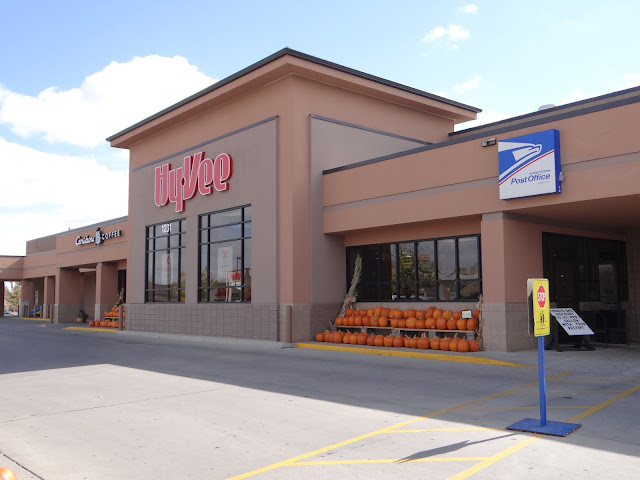
The largest city in one of the nation's least-populous states is rather remarkable in that it possesses, besides its main post office, one classified station and 14 CPUs. They are designated numbered stations 1 through 14. Thirteen CPUs are locations of two regional chains: Lewis Drug's and Hy-Vee. There are six of the former and seven of the latter, respectively. USPS's 2012 CPU Directory only accounts for six Hy-Vee locations, however.

Sioux Falls, SD: HyVee CPU (Station 12) Sioux Falls, SD: Hy-Vee CPU
New York City

  • Multiple listings: "Mr. Mailman" and "Mr. Mailman on 53rd Inc" are one and the same. Kate's Market Place in Breezy Point is listed twice despite the fact it opened this past year.
  • Better Letter, the CPU I wrote about last March, is also listed twice -- despite the fact that it was forced to shut down on May 30. (The "A&L Management" listing from the Bronx -- that is the Bathgate CPU -- and Brooklyn's Rita's Dry Cleaners CPU suffered the same fate.)
  • Among the absences is Fordham University's CPU (Station #37) in the Bronx.
  • JW Pharmacy in Flushing, NY is not an actual CPU, though it is listed.

Long Island

  • SUNY Old Westbury's CPO is absent, as is the SUNY Stony Brook CPO which closed December 2011. (If Better Letter, which was not open at the end of FY 2012, is listed, shouldn't this be as well?)
  • East Hampton's The Corner Store CPU is absent.
  • Fire Island's Davis Park CPO is absent.
  • Fire Island's Kismet CPO is misspelled 'Kismit'.
  • Depot Stationery is misspelled "Stationary" [see below]. Stationary means 'not moving', though I suppose that is a good quality for a given postal operation these days.
  • The Fair Harbor CPO is proceeded by "SEAS", meaning seasonal (as in, open only during the summer); interestingly, this annotation is not applied to the other CPOs on Fire Island, for which this is also true.
Huntington Station, NY: Depot Stationery CPU

There are many more errors or inconsistencies where these came from. As such I believe this response to the Chairman's Request should be remanded for further consideration.

Wednesday, February 15, 2012

Helping USPS Help You

When I visit post offices, I don't just take photos and collect postmarks. Well, usually I don't have the need to do anything else, aside from possibly bantering with cool folks, but occasionally there's more work to be done.

I note these changes because, in my view, providing superior customer service and best engaging and maintaining existing customers is a key to maintaining revenue and assuring the future success at USPS. Hence, I thank the Philadelphia Metro District and patient staff at the Philadelphia Post Office for listening to me and working to improve the customer experience at their locations.

It should be noted that by and large I've dealt with highly competent staff and friendly offices. The following three changes were implemented to address aberrations.

Issue 1: Long Lines
By the Law of Large Numbers, if you do something enough times you'll see everything. But recently I saw a line at a post office that was just too long. In fact, I saw it twice -- once at 1:30, and again at 4:45 when I returned to get my postmark a second time. The line was a solid 25 to 30 people long, and wait times were excruciating. The line was to the door, and then halfway back to the counter. There were two clerks operating each time, and two other stations vacant. Yet no backup was forthcoming. (Since I was also visiting every NEIGHBORING post office that day as well, I can bear witness to the fact that there were short lines and potentially a clerk to spare at a couple of neighboring offices. But really, who else would know that?) Here's a photo I snapped the second time around:


It's not the clerks' fault, a fact that I expressed to nearby agitated customers -- staff at all levels has been forced to cut back to save money.

When brought to the attention of Philadelphia Post Office management, it was agreed to that management would monitor the situation and assign a supervisor to visit the station on a more frequent basis to ensure the wait times remained acceptable.

(Current USPS national standards call for wait times of no more than five minutes, for the record.)


Issue 2: Not offering full services during business hours
The Franklin Mills Mall is huge. HUGE. 1,600,000-square-feet huge. Fortunately it has a post office! Not only that, but as a function of USPS's lease with the mall (as it is at many such locations across the country) the Franklin Mills post office must be open during all mall hours. Presently those are Mon-Sat: 10:00am-9:30pm; Sun: 11:00am-7:00pm.


For you Googlers who are trying to find the place -- it took me 25 minutes -- it's on the east side of the building, at the blue entrance. Fortunately there's a little blue-and-white Sonic Eagle logo there!


In any case, the Philadelphia postal system is quite uncommon and impressive as it has TWO USPS-operated facilities that offer customer window hours seven days a week. I think it's a mark of pride. The bizarre thing is that, for the first time I'd ever seen in then-2,500 post offices, they weren't offering full services at the time. After 1 p.m. (for a while changed to 6 p.m.) the location would not accept packages; the postmarking devices were locked up; and all they could do were sell stamps and money orders. This was true for all of Sunday as well.

(For a moment here, think like a customer who just found out there's a post office open Sunday. You rush down, you hack through the maze of the mall as you would a jungle, you find the post office... and... they tell you you have to come back Monday. Is that going to help business?)

I inquired and that's apparently just the way it had always been done. The reason is that there was no dispatch after 1 on Saturday or at all on Sunday; USPS didn't want it to appear as though the packages had been delayed. But if you want to mail a package, and it will arrive at the same time anyway, wouldn't you just want to send it and not have to return on Monday? The packages could always be stamped "Received After Final Dispatch." And what's it costing the postal service if the location must be staffed full hours, anyway?

Good news: Two weeks ago the District Manager agreed to ensure that the location offered full services during all business hours!

Here's a snippet:


I think it would be apt to use this as a demonstration of commitment to customer service -- imagine, two full-service offers, seven full days a week! Seriously, why not get the word out? I'm sure the mall would appreciate it, too. I hope that this raises awareness toward the availability of postal services at Franklin Mills and draws more customers to utilize this location at their convenience.


Issue 3: Illegible Machine Cancels
I sent the below letter to my dad. I put a nice stamp on it, but as you can see both the letter's origin and date of mailing are completely illegible.


In actuality I mailed it the last day that 44-cent stamp was valid -- which is obviously why I was sending several pieces of mail that day. (It was Jan. 21, and from Philadelphia, for the record.) In any case, that isn't good. So I brought attention to the issue and I again appreciate that the District Manager addressed the issue when it was brought to his attention:

"The situation you described was brought to the attention of [the] Senior Plant Manager ... He has directed the Maintenance Department to inspect the print heads on every machine and correct any deficiencies. This course of action will insure cancellations are legible."

Based on the envelopes I've received from around the country, this should be common practice everywhere in the country -- the issue is prevalent.

Especially given as tax season is just around the corner, I know the public appreciates the quality of good cancellations. And it's an especially relevant concern given this potential Congressional bill, which would force a company to acknowledge a mailed bill as having been paid on the day during which it was postmarked. (That legislation strikes me as a bit odd, because I thought that was federal statute anyway. Apparently some companies have been ignoring postmark dates and charging customers late fees after having held mail, unopened, for several days. Regardless, legible postmarks are important.)


Generally speaking, the Postal Regulatory Commission (PRC) Contact page is INCREDIBLY useful toward resolving any postal issues you might experience -- if, in fact, you have any that can't be resolved at local levels or if you just don't know who to contact. Just be sure to be accurate, be precise, and do be polite!