Showing posts with label beautiful offices. Show all posts

Friday, November 26, 2021

The 2022 Calendar of Post Offices and Places

[Note: Direct purchase link: here.]

Well! I cannot believe this year is almost over. Postally speaking it hasn't been incredibly productive, though I still have plenty of stories to share. It has been tough to feel motivated since I've been unable to travel and experience many places first-hand; BUT, I have gotten a couple of posts out lately and I do hope that productivity continues. And perhaps most importantly, of course, there's the sixth annual Postlandia Calendar of Post Offices and Places!

Every month of the calendar features a photo and caption of a photogenic and/or historically significant post office. The P.O.s featured come in all manner of shapes, sizes, and—I kid you not—colors. It can take quite a bit of research (particularly old newspaper articles) to get to the bottom of some of their stories!

This year's calendar [← direct link to order] takes us from Appalachia to the Pacific Northwest, New England, California, and many places in between. We've got a post office surrounded with wagon wheels; a pink castle; and one of my absolute favorite post offices, in Pennsylvania (see below). We also visit what's known as the smallest post office in America: Ochopee, Florida, and I'll show it to you in a way you probably haven't seen it before.

Writing this as I usually do right around/during Thanksgiving, please allow me to publicly appreciate everyone who supports this crazy little endeavor of mine by purchasing a calendar. It both motivates to keep going and literally helps me keep going in the form of gas money! I might drive 2,000 miles over the course of a week as I visit 150 post offices on the road. It adds up!

2022 Postlandia Calendar Cover: Greenville, PA post office


I first wrote about Greenville eleven years ago, but have revisited the post office both physically (for better photos) and in terms of research. I even mentioned it on NPR back in 2011 as perhaps my favorite post office of all! I absolutely love this building and I hope you will too. More 2022 calendar highlights include:

California: The Castle


South Carolina: Take it for Granite


New York: Something Blue


In addition to (U.S.) holiday designations the calendar features notes about interesting dates in U.S. postal history. I've gotten feedback from several people saying they find that detail really cool.

Everyone I know who's gotten the Postlandia calendar in the past has enjoyed it. It's a fantastic gift for philatelists, people who love exploring off the beaten path, and current or former U.S. Postal Service employees! I've been using the printer Lulu for a long time and they always churn out consistent, high-quality calendars. The paper is thick, the colors come out great, the images are nice and high-resolution (far higher than I post online), and it easily holds up to writing in pen or Sharpie.

(For the sake of reference, here are the links to 2017, 2018, 2019, 2020, and 2021 calendar write-ups.)

One fun thing I like to do, when sending out orders from family or friends, is wallpaper the heck out of the envelope with loads of cool old stamps. You can find a handful of examples here, here, and here (← definitely worth the look)!

Again, here is the link to ordering the calendar online. Thank you everybody for reading, liking posts, commenting, sharing, and for your support. Here's hoping to a happy and healthful 2022! —Evan

Thursday, November 8, 2018

The 2019 Calendar of Post Offices and Places

Welcome, welcome, welcome! It's that time of the year again—time for a brand-new iteration of the Postlandia Calendar of Post Offices and Places [update, 2019: product no longer available; link removed]! I'm super-excited for the 2019 edition, which features 12 all-new images of wonderful post office buildings from across the country. I've taken most of these images during the course of my travels spanning all 50 states, and I'm delighted share them with you now.

The 2019 edition takes us thousands of miles: from Hawaii to New England, Utah to Appalachia, and the Northwest to the Heartland. We'll visit a dozen new post offices large and small, urban and remote, each with a distinctive story.

The images are printed in high-resolution on high-quality paper. The dates include not only U.S. holidays but dates significant to American postal history. And, yes, you can write on it! Your ink will not bleed through to next month's organic / fair trade / hand-crafted / barrel-aged post office photo.

Postlandia Calendar cover:


With Postlandia I've always brought you the stories behind the post offices and communities of America, and here you can explore another wide-ranging cross-section of the nation. These photos take you not just from time zone to time zone, but span history as you explore photos from two centuries (from more than 100 years ago to the present).

Where else can you find the post office with ten-minute parking—only for bicycles? Or the post office with a block-long light fixture? How about the 1870 Gothic P.O. that's now a restored event space? There's an archival image of a post office that Franklin D. Roosevelt had a hand in designing, as well as some New Deal artwork. There are also great images of some of the nation's smallest post offices! And more. As always, here you don't just get photos, you get the story behind what makes them unique.

Rhode Island: the post office with its own postage stamp


Kentucky: Lost Americana


Crossroads of America: Postal Gothic

Again, there's so much more where these came from. I hope you experience as much enjoyment with this calendar next year as I've enjoyed curating it. Remember—I've trekked to thousands of post offices so I can bring you some of the very best, anywhere.

Dozens of calendars have already been sold so far this year, and I thank everyone for their support! (It really does make a dent in my gas money bills!)

This is the perfect gift for the special USPS employee in your life; a perfect purchase for philatelist and stamp collectors; and generally speaking, just the perfect post office calendar. The calendar is available at the secure website of the high-quality printer Lulu. Everyone I know who's purchased either the 2017 or 2018 Postlandia post office calendar has loved it!

BONUS!!

Do you love those historic 1930s post offices, more than 1,000 of which house beautiful examples of New Deal artwork? This year I'm introducing a second Lulu calendar: New Deal Legacy! It starts with a bit of postal goodness from the FDR era, but goes way beyond to highlight some of the myriad of accomplishments put forth by various New Deal agencies across the country, including: the Works Progress Administration (WPA); Public Works Administration (PWA); and Civilian Conservation Corps (CCC).

2019 New Deal Legacy Calendar cover:
The projects range from massive developments, to magnificent artwork, to minor local projects that have stood the test of time.

Michigan: Art Deco goodness


Utah: State Capitol grandeur:


The high-resolution images—which range from the 1930s to the present—include the stories that make each one image significant. They are printed on thick, high-quality paper and will hold up to all of your writing-on-your-calendar needs.

Thank you for your continued support!!
Evan

Monday, September 17, 2018

Z is for Zanesville

Ohio is great for alphabet enthusiasts. It has communities (read: post offices) beginning with all four of the rarest letters of the English language: J [Jackson, Jackson Center, Jacksontown, Jacksonville, etc.], Q [Quaker City, Quincy], X [Xenia], and Z [Zaleski, Zanesfield, Zanesville, Zoar]. (How do you know they're the four rarest letters in the English language? Look at the values of their Scrabble tiles.) Here we look at the post offices of Zanesville, which was named after Ebenezer Zane, "who had blazed Zane's Trace, a pioneer trail from Wheeling, Virginia (now in West Virginia) to Maysville, Kentucky through present-day Ohio." (Zanesfield, for the record, is named after Ebenezer's brother, Isaac.) Zanesville is located along I-70, about 55 miles east of downtown Columbus, and has a population of about 25,000.

Zanesville is roughly trisected by two rivers: the Muskingum and Licking. Where the rivers meet is an interesting structure called Y-Bridge: literally, it's... well, here's a satellite view. The Muskingum River is the wider one, flowing from north to south. The Licking River comes in from the west. Downtown Zanesville is located east of the Muskingum River.


As Exploring the Ycity puts it, "This bridge is allegedly the only bridge in which you can cross and still be on the same side of the river."

The Zanesville post office was established in 1801, at which time "enough people settled in Zanesville that the Postmaster in Washington, Ohio wanted a post office to be placed in Zanesville. At the time, McIntire had dubbed the town Westbourne, however the Postmaster saw that the town intersected the Zane Trace and that Ebenezer Zane had originally owned the land, so it official became Zanesville, Ohio and the name has stuck ever since."

Downtown, at the northwest corner of South St. and S 5th St., stands a stoic a building. Stone eagles stand watch over the entrance. Its pillars are wrapped with vines, as is one of the domed lighting fixtures out front. The historic United States Post Office and Federal Building was built in 1904; while the Beaux Arts-style building is presently listed on the National Register of Historic Places, its NRHP file does not appear to have been digitized, making additional information (beyond the rudimentary) difficult to come by. In any case, the building presently serves no discernible function, appearing largely abandoned, possibly since 1965, when the current Zanesville main post office was occupied.

Zanesville: old Federal Building

Zanesville: old Federal Building

The 36,000-square-foot main post office, at 900 McIntire Ave., is located north of the Licking River and I-70. It's a standard-issue '60s design and effectively functions as a carrier annex—retail functions have since relocated.


Main retail operations have been located at 1035 Zane Street, a 7,800-square-foot facility by the eastern edge of the Muskingum River, since 1998. The facility alternatively goes by "Zane [Street] Station" or "Finance Station." Zane Street post office

Finally, three miles north of the MPO is a mall post office, located inside the front entrance at Colony Square Mall. I found the clerk (and the Postmaster, who dropped by) to be very friendly. Bought a bunch of stamps from them!

Colony Square Mall entrance

Colony Square Mall Station post office

'Til next time!

Thursday, November 9, 2017

The 2018 Calendar of Post Offices and Places

Please check the newest entries in this blog for the most current link to the most current Postlandia calendar! ---- It's that time of the year again—that time I somewhat shamelessly inform you of the amazing and fantastic new Postlandia Calendar of Post Offices and Places! This year's [the 2018] iteration features 12 all-new and unique images, from a dozen different states. And these are really good ones!

Postlandia calendar: partial cover
Cover snippet

With Postlandia I've always brought you the stories behind the post offices and communities of America, and here you can explore a wide-ranging cross-section of the nation. This year's offerings transport you across the United States: Alaska, the South, New England, the Upper Midwest, California, and the vast and empty West. These photos take you not just from time zone to time zone, but span history as you explore photos from two centuries (taken from 1900 to the present).

Where can you find a literal 'floating post office' that rises with the tides? How about a vintage Vermont general store (and post office, of course) that appears today just as it did 100 years ago? The calendar also features the 1910 New Ulm, Minnesota post office, which was so distinctive that its construction essentially forced the government to re-write its design standards. And then there's the post office on a ranch in the middle of nowhere, and I guarantee it will floor you. (This particular location took me an hour and a half to find as I drove through the high desert this summer; for you it will have definitely been worth the wait.) And there's more. Much more. As always, here you don't just get photos, you get the story behind what makes them unique.

All images in the calendar are full-page and high quality. And, with each photo, there's full text at the bottom that explains exactly what's going on. Here are peeks at just a few of the images (which have been cropped to show detail on your screen)!

Minnesota: there's no place like New Ulm
New Ulm, Minnesota post office calendar image

Montana: last looks at a ghost town P.O.
Montana post office calendar image

Vintage Vermont
Vermont post office calendar image

Again, there's so much more where these came from. I hope you experience as much enjoyment with this calendar next year as I enjoyed piecing it all together this summer. Remember, I've trekked to thousands of post offices—across all 50 states—to document as many post offices as I can, so I bring you some of the very best, anywhere.

I really do believe this is the perfect calendar for USPS employees, a great gift for the mail carrier in your life, a perfect purchase for philatelist and stamp collectors, and generally speaking, just the perfect post office calendar. The calendar is available [Nov. 2018 edit: link removed], at the website of a high-quality printer called Lulu. The calendar even has the honor of being on the printer's Holiday Gift Guide! Again, you can find it here, and everyone I know who's purchased either the 2017 or 2018 Postlandia post office calendar has loved it.

Thanks, Lulu!
Postlandia is awesome

Wednesday, August 9, 2017

Flying the 46-Star Flag

There's a lovely residence in the old seaside town of Waldoboro, Maine with a long back-story. And a slick Sotheby's real estate promo video for when it was recently sold. Ladies and gentlemen, presenting 908 Main Street:


The building was constructed pre-Civil War as a federal building: Custom House and Post Office. Wiki: "This building was erected in 1855 by the U.S. government on the site of Hon. Isaac Reed’s apple orchard. The Post Office occupied the first floor and the Custom House the second. From 1855 to 1904 it existed as a customs house, handling all shipping business in the Waldoboro Customs District, an area [extending] from Bristol to Northport. By 1853, this district took care of more shipping business than any district in New England, save Bath and Boston. By 1900, however, shipping had declined precipitously. In 1909 the building was renovated to install a new plumbing and heating system and to add a twelve-foot addition at the rear of the building. Soon after, The Customs District of Waldoboro was abolished and the Custom House closed."

Anyway, about here (1909) is where we come in. At the National Archives there are photos of hundreds of federal buildings at the time of their completion; in fact, contractors offered such photos as proof that their work was completed (and thus, get paid in full). You'll most often find pairs of such photos, taken from opposite corners to show all faces of the building. I've scanned and posted many of these, of course, at the PMCC Online Post Office Photo Collection. You may have seen a couple of these in my Big Sky, Big Post Offices entries (to wit: Missoula). Photos were taken upon completion of an all-new post office / federal building, or upon completion of a major renovation / building extension. Such would include that "twelve-foot addition" mentioned above.

There are three photos—undated—in the Waldoboro file, which effectively show us a 360° view of the post office:


The "twelve-foot addition" would be an enlargement to the rear and correspond roughly thusly:


So can we date this image to the time of the addition? Fortunately, the generally high quality of these images and the American flag help us out. Because at this time we did not have 50 states, and if these were taken in 1909 we wouldn't expect to see even 48 stars on the flag. Rather, we'd expect to see only 46. The 46-star flag would have been in use between 1907/8 with the statehood of Oklahoma, and 1912 for the statehoods of Arizona and New Mexico.


So is that what we see? Zooming in on the second of three images of the post office above, we can see that the answer is a definitive yes; we see six rows of stars: 8-7-8-8-7-8. In this case it's best to compare the alignment of the first star in each row to see that this is how they pan out. This places it firmly between 1908 and 1912, so these were most likely taken at the end of construction work on that 12-foot addition. (See ushistory.org for more about U.S. flag designs and the dates they were used.)

Hope you enjoyed some photos of a stunning old P.O., and a little explanation of one way to date historic images.

Wednesday, August 2, 2017

The Lost Post Offices of Magoffin County, Kentucky

Once in a while a collection of post office photos truly astounds me. This was the case when Postlandia friend John Gallagher—45-year postal tourist of 35,000+ post offices—sent me photos from one day in rural, Appalachian Kentucky in the 1970s. The vast majority of the photos were taken in population-13,000 Magoffin County.

When John and Alan Patera visited the area in May 1978, Magoffin County was home to a whopping 36 post offices. Today it has two. Mash Fork, Wonnie, Fritz, Gypsy, and Lickburg are just a handful of the many unincorporated rural communities that housed post offices, since discontinued. Several were in rundown shacks that could compete for title of Smallest U.S. Post Office. Many stood proud with rustic, unique, and utterly stunning hand-painted signs; others were barely identified at all. All contribute to this snapshot of a piece of Appalachia since lost.

Here are a handful of images to whet your appetite:

Printer, KY post office:
Printer, KY post office

Wheelersburg, KY post office:
Wheelersburg, KY post office

Waldo, KY post office:
Waldo, KY post office

View the full album of images here. There are 36 photos in all, and they are all fantastic.

The images are randomly sorted. Dates of discontinuation are included with the images, as known. The two post office still operating—Salyersville and Falcon—have since relocated. The PMCC's online post office photo collection has the images of the present sites as well.

Wednesday, August 3, 2016

Looking Back on Luckenbach

Luckenbach is a fun find. Located in the heart of Texas Hill Country, this once-thriving German community is 13 miles from its county seat and a few miles south from U.S. 290. The community is roughly between Fredericksburg and Johnson City (think: L.B.J.-family Johnson), and there are a handful of photogenic post office buildings in the area. Luckenbach's own post office operated between 1850 and 1971. Though it's been closed for 35 years, the remnants of the town's general store and post office (not to mention Luckenbach itself) continue to draw tourists from all around.

Here's the general store and old P.O. outside:


In addition to the commemorative signage outside, the building still houses its old post office sign inside, as well as its general delivery boxes and even the old safe. For those who ask they even have a commemorative "postmark" that you can stamp items with.

The general delivery window with sign in the background:


The old safe:


Looking toward the front:


One interesting thing that's easy to overlook is a strip of tape on the floor of the building. It served as the dividing line between postal property and the rest of the general floor facility. Patrons had to be sure not to bring any alcohol across the line onto the postal side. This gentleman is on the general store side of the tape.


Visit the official Luckenbach website here! It's a nice place with friendly folks. And a fun postal find.

Saturday, June 25, 2016

Sculptures and History in Ridgewood, New Jersey

Look closely while passing by the post office in Ridgewood, New Jersey, or you might end up doing a double take. At first glance, particularly from across the street, it appears as though the well-dressed mailman out front needs assistance delivering a letter! Alas, the sculpture "Special Delivery," [undated], created by J. Seward Johnson, is part of an outdoor sculpture initiative. Its placement at the Ridgewood post office, a New Deal construction that itself bears sculptures created with the goal of expanding cultural access in public spaces, is particularly apt.

Special Delivery, Ridgewood, NJ

The village of Ridgewood, located approximately 20 miles northwest of Midtown Manhattan in Bergen County, New Jersey, is home to 25,000 people. The Ridgewood post office was established in 1865. It received a federal New Deal facility during the Great Depression; construction began in 1937 and was largely completed at the beginning of 1939. Here, photos of the front entrance to the post office and its cornerstone.

Ridgewood, NJ post office

Ridgewood, NJ post office cornerstone

The ornamentation above the entrance to the post office is particularly stunning, and unlike that I've witnessed anywhere else during my travels. It is in apparently great condition and, as early photos you'll soon see show, it is original to the building.

Ridgewood, NJ post office: entrance ornamentation

A treasure trove of photos of the newly finished facility are available at the National Archives, a few of which are shown below.

This photo from February 1939 gives you a taste of the Deco ornamentation that encompassed the entire building. You can also see a then-newly-planted tree and numerous additional ornamentation details (above and below the windows, and along the roof line) on the post office exterior that have since been removed. The large tiles have also been replaced with brick.


The building just does not bear the same visual presence without them.

From January 1939: a photo of the post office lobby showing the large tiles, era lamp, and Deco radiator motifs. A second photo shows part of the work area at the same time.


One wonders who the two gentlemen at the right are!

Soon after completion the artist Romuald Kraus was commissioned by the federal Treasury Section of Fine Arts to create a pair of sculptures to be mounted in the post office lobby. Respectively, the untitled work (?) depicts a male and a female figure. The pair of metal reliefs were installed in 1940 and can still be viewed today.


As can be seen from the photo below (showing the sculptures in context), some of the interior magic of the lobby has since been lost, particularly in the replacement of the Deco radiator grilles and light fixtures, as seen above. Much of the tile design appears the same.


The Ridgewood post office is a site of some unfortunate infamy: in 1991, a recently fired postal employee committed four murders, including two at this post office. (You can read more details here, if you're so inclined.)

Three years later tragedy struck the post office again, when mail carrier Julio Cruz was killed after a tree collapsed onto the front of his mail truck. A plaque [visible at the right side of the above interior photo] in the post office was placed in memory of Julio. (The author believes a second plaque, to the left, honors the fallen employees from the incident in 1991; alas, he didn't know to check at the time so he's not certain.)

Facing south, the building is particularly photogenic on a sunny day. During such an afternoon you can snap a beautiful photo, from a high vantage point, of the south and west faces of the building from Van Neste Square Memorial Park. The park is located kitty-corner to the P.O.


I took a second look at Special Delivery out front. If you look closely, even the letters the carrier is delivering are parts of the sculpture. I'm not too sure everyone would like to be the recipient of these particular letters, however; if you inspect closely enough you can see that the letter is an official business envelope from the Internal Revenue Service in Atlanta, Georgia!


Monday, December 8, 2014

Historic Post Offices of Louisiana, Part III: Baton Rouge

Oh my goodness, has it been this long since the first two of our trilogy? I had planned to write about how I was harassed by a misinformed U.S. Postal Inspector while taking the photo you'll see below (an Inspector who utilized the words "domestic terrorism" and attempted to get the U.S. Marshals to confiscate my camera; fortunately the latter knew better than to oblige)... and then describe the federal lawsuits that have resolved that it's perfectly acceptable to photograph anything visible from a public street, sidewalk, or plaza. But we're better than that. So, onward.

The downtown post office in Baton Rouge, also known as the main office retail unit, is located in a '60s-era Federal Building across the street from the old Main Post Office for Baton Rouge, which now serves as a Federal courthouse. (A third Federal building was constructed in 1990 next door to that.)

Let's take a look at a map of the downtown postal operations in Baton Rouge:


In the map, the 1930s old post office is located at the north side of Florida Street; the 1966 facility you see below, on the south side.

Here is my photo of the '60s post office / federal building taken from across the street. (The Inspector and two ill-trained rent-a-cops can be seen at the right side of the image. Here's the point at which I was about to have a very interesting afternoon.)


Here is a photo of the exact same building taken by a Google Street View car the same month. That driver's afternoon was probably less eventful.


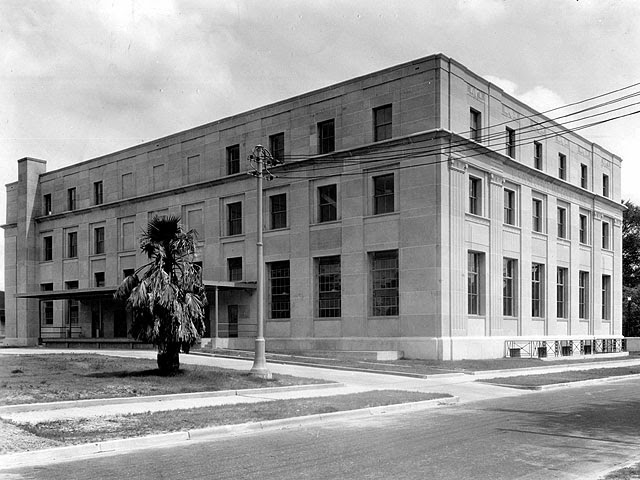
There's not too much else to say about the 1966 post office building. It has a large carrier station in the back. The old building (now-just U.S. Courthouse) across the street is much more architecturally interesting. That's partly because I like the architectural flair of the 1930s. The General Services Administration (GSA), which manages the building, describes the nuances of the architecture as well as the building's historical significance. But first, here are a couple of images. The first two are mine from this past April. The next three are from the National Archives collection in College Park, Maryland. The cornerstone demonstrates that construction of the building began in 1932, during the administration of Herbert Hoover. The building was completed the following year, once FDR had taken office.

Baton Rouge, LA: Old Post Office and U.S. Courthouse

Baton Rouge, LA: Old Post Office and U.S. Courthouse Cornerstone

From the National Archives; photos taken upon building completion, May 12, 1933:
Baton Rouge, LA: Old Post Office and U.S. Courthouse, 1933

Baton Rouge, LA: Old Post Office and U.S. Courthouse rear, 1933

Baton Rouge, LA: Old Post Office and U.S. Courthouse detail, 1933

The Neoclassical building was designed by architect Moise Goldstein and built by the firm of Algernon Blair, contractor, whose company was responsible for the construction of at least 20 post office/federal buildings in Louisiana during this era. The building sits on a granite base though is clad in limestone. The total floor area is 57,000 square feet and the building underwent a substantial renovation in 1995.

The building's site has been owned by some government—initially state, then municipal, and finally federal—for nearly 200 years, serving as a state penitentiary, a park, and even a community center.

The GSA writes:
"The passage of the Public Buildings Act of 1926 precipitated a period of building construction that was unprecedented in the United States. The Public Buildings Act specified that the office of the Supervising Architect of the Department of the Treasury would be responsible for the design and construction of all public buildings. Due to the failure of over half the nation's architectural and construction firms in the Depression, many of these buildings were designed and constructed by local firms, as was the Baton Rouge building. Many of the federal buildings of this period exhibit streamlined design and lavishly finished interiors featuring marble and aluminum trim, and well-appointed courtrooms. The Baton Rouge Federal Building and U.S. Courthouse is representative of this period of construction in the United States."

The GSA also posts a couple of low-resolution photos, taken 2003, to its website. Interior photography is prohibited within this building, so these images are the best we've got. Here: the ceiling, a pillar, a staircase, and a lamp.


I'll leave you now with a couple of architectural detail photos that I took, once the Marshals correctly determined that, from a legal perspective, everyone should leave the architectural tourist alone! I think the pictures came out quite nicely.

Let's admire the ironwork above the front door:


Now, let's look at the stone eagle above that (which, if you observe closely, looks just as it did 79 years ago in that enhanced photo from the National Archives that appeared earlier!):


Finally, the eagle in its setting above the front door. There's immaculate stone-carving work to accommodate the iron detailing as well!


For the sake of completion, the basement of the massive Louisiana State Capitol building contains a postal station as well. What's interesting about that building is that you can get a great panoramic view of the state capital region (and of one of the largest oil refineries in this hemisphere) from the wraparound terrace of the building's 24th floor.

Baton Rouge, LA: Capitol Station post office:
Baton Rouge, LA: Capitol Station post office

Well, thus concludes this Louisiana postal trilogy. I'll work to update this a couple more times by the end of the year. Until next time,
Evan the Traveler